
Windmills
Wind is caused by planetary forces as old as the world itself: the sun heating the atmosphere unevenly, geographic irregularities, and the rotation of the Earth. Wind flow patterns are shaped by the mountains and valleys, bodies of water and even vegetation.
‘Wind Energy’ is when the wind is harnessed to drive mechanical machinery or used to generate electricity. Usually the wind drives a blade around a shaft to convert the kinetic energy in the wind into mechanical power. The blades ‘dance’ in the wind to pump the water or produce the electricity we need.
Wind energy has never been this exciting. For Turbex Windmills, it’s been a lifetime of discovery. We’ve learnt that you can’t bend the wind to your will—the wind bends you. You have to adapt to what it offers. You have to optimise your designs to the awesome power it holds.
Turbex have been allowed to mix artistry and engineering to produce machines that have withstood the rigours of nature for over 40 years.
Today, our products challenge the best in the field, yielding top-in-class performances in most real-life applications. Over the decades we’ve manufactured, sold and installed hundreds of these machines— most that still run reliably today.
Turbex pioneered a windmill design. Traditionally, windmills used a reciprocating or piston pump. The problem with the reciprocating pump is that it only pumps water 50% of the time. The Turbex uses a helical pump driven by a gearbox to give a continuous, smooth pumping action.
This means that the Turbex will pump between 2 and 3 times more water than a reciprocating pump for the same-sized installation.
The Turbex has been installed in Australia, Queensland, New Zealand, Spain, Sweden, England, Ireland, North America, Texas, Minnesota, Missouri Canada, Israel, Botswana, Zambia, Angola, Namibia, Mozambique, Niger, Malawi, Malaysia, UAE, Zimbabwe, Sudan, and off course, South Africa.
Turbex Windmills
Turbex Windmills offer reliable, cost-effective, and high-volume water pumping solutions, leveraging modern rotary pump technology for superior performance over traditional wind-powered systems.
We offer three primary sizes, each suited for different water volume and depth requirements.
| Model | Diameter (Wheel) | Typical Tower Height | Key Features & Application |
| 3,3m (10ft) | 3.3 meters | 6m, 9m or 12m | Smallest size. 36 wheel blades pump water in the slightest breeze. |
| 4,6m (15ft) | 4.6 meters | 9m or 12m (30ft) | Most popular model. 42 blades. Ideal for boreholes typically 60m (220ft) to 140m (400ft) head. Widely installed across Africa. |
| 5,5m (18ft) | 5.5 meters | 9m, 12m, 15m, 18m | Flagship Model for high volumes of water. Typical application: Pumping high volumes of water from a dam or river to another reservoir. |

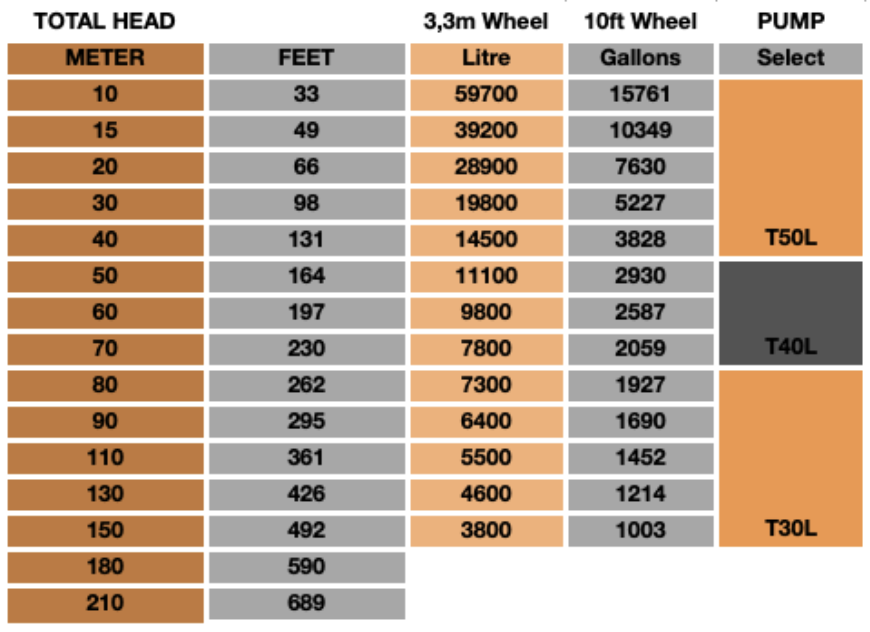
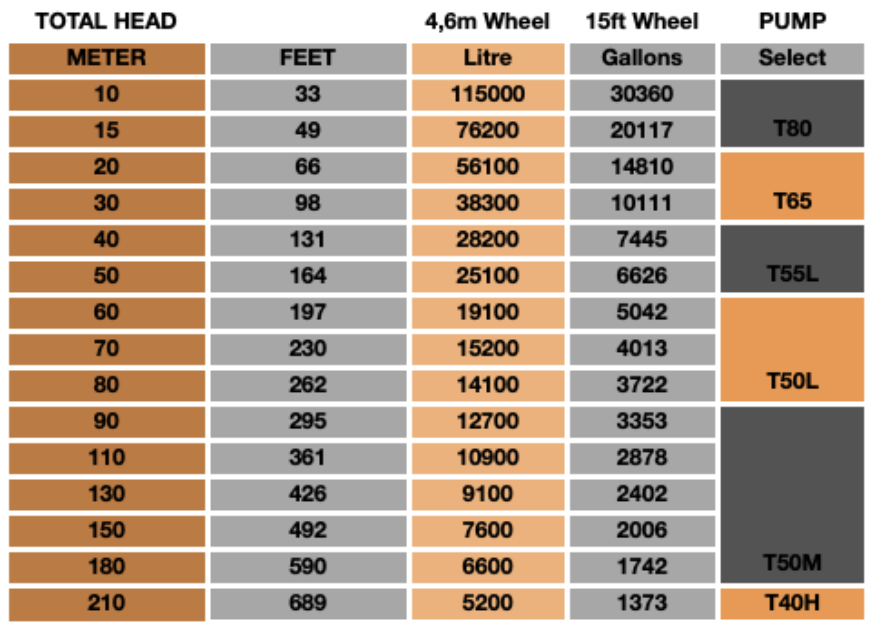
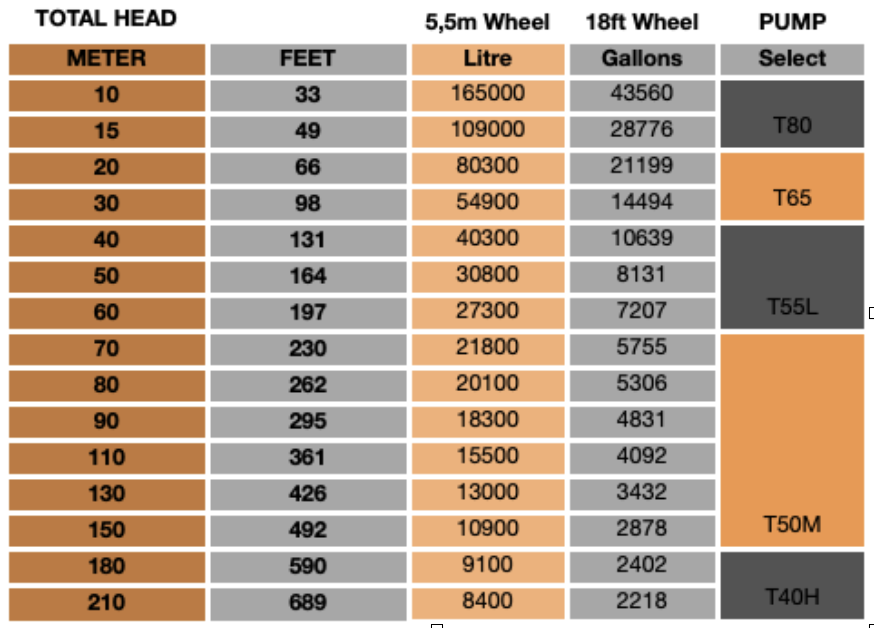
These tables suggest expected water delivery figures for the Turbex water pumpers with a helical rotary bore hole pump connected to its drive at an average wind speed of 20km/h (12m/h) in an area without major wind obstructions. An optimum wind wheel to pump relationship assumed.
Other Technical Information
2.1 The Pump and its Reach (The Sump)
The Turbex Windmill is versatile and capable of pumping water from significant depths and distances.
Borehole Pumping: Typically used to pump water from boreholes up to 180m in depth.
Suction Limit: The borehole pump must be installed no higher than 6m from the water source (suction limit).
Maximum Discharge: It can push water up to:
180m vertically (head).
24km horizontally (distance).
Alternative Application (Dam/River): The pump can be installed in a sleeve to draw water from a dam or river and push it up to a reservoir.
Sump Installation: The pump is usually installed in the center of the tower in a Turbex sump type, allowing the discharge head and pump inlet to exit at the natural ground level.
2.2 Pumping from a River or a Dam
The Turbex windmill is highly effective for pumping water from surface sources:
Installation: Installed on a suitable spot next to the river, fountain, or dam.
Suction Distance: The unit can be installed quite a distance from the water source, provided the intake suction point of the pump does not exceed about 6m in height from the water level.
Connection: A thick-walled plastic pipe connects the pump (installed at the Turbex) to a suitable suction point in the river or dam.
2.3 The Modern Helical Rotary Pump
Every Turbex windmill utilizes a helical rotary pump driven by the wind, which is a major differentiator from traditional wind pumps.
Rotary Action: This modern pump rotates, unlike the reciprocating (up-and-down) motion of traditional wind pumps. This technology is the leading borehole pump type in South Africa.
Advantages of Rotary Windmills
| Advantage | Turbex Performance |
| Increased Volume | Pumps more water than other alternative systems for smaller installations, dramatically reducing pumping costs. |
| Example (4.6m Model): | In a 20 km/h wind on a 30m (100ft) borehole, it delivers 30,000 liters per day (almost 11 million liters per year). |
| Greater Depth | Can operate at depths of up to 200m – 240m. Very few other wind-driven units can reach these depths. |
| Long-Distance Pumping | The windmill can be installed at the water source and pump water for kilometres. |
| Example (Smallest Model): | The 3.3m model maintains 1,000 liters/h over a distance of 15 km in a typical 20 km/h wind using a 40mm pipeline. |

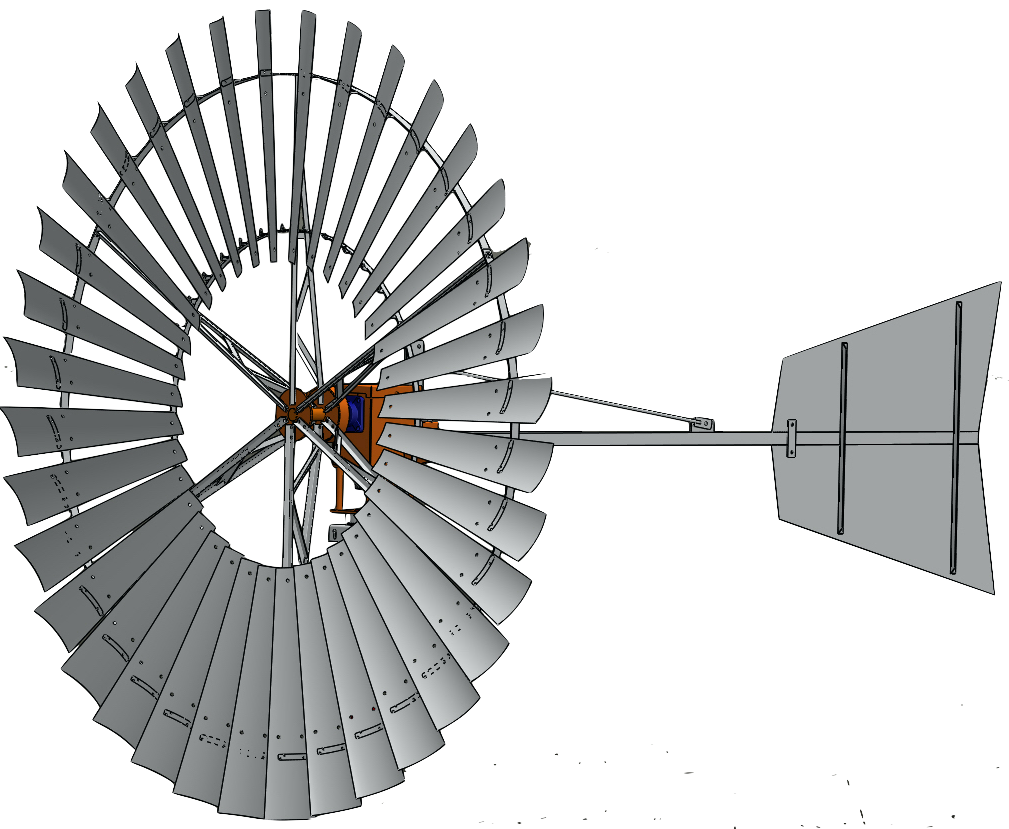
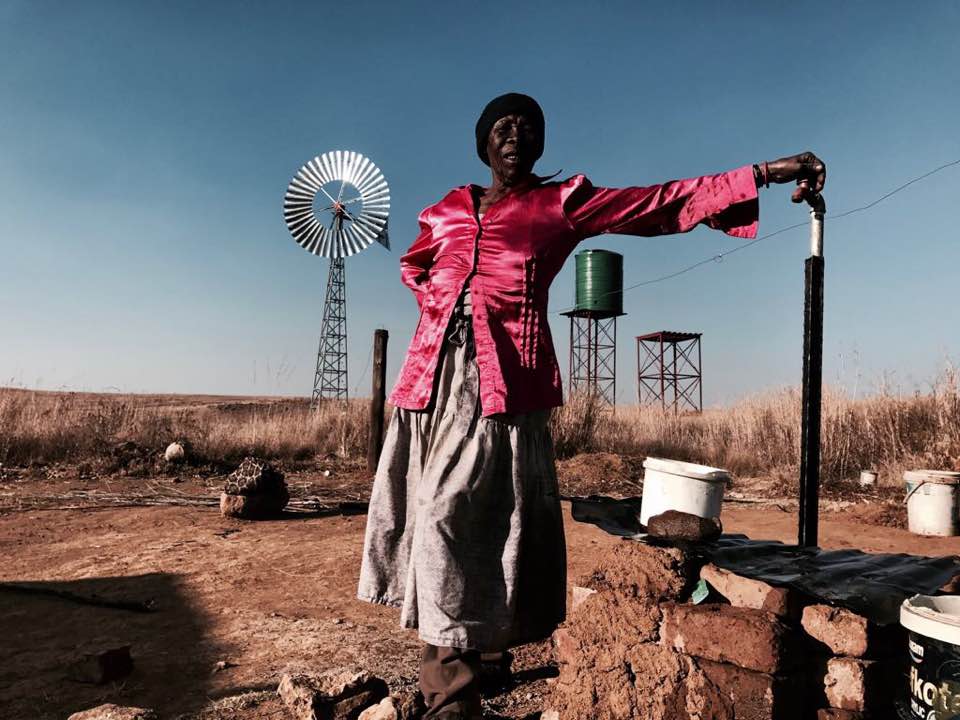
3,3m(10ft) Turbex Windmill with 6m Tower Complete
4,6m(15ft) Turbex Windmill with 9m Tower Complete




2.4 Irrigation Capability
For high-volume irrigation from surface water (dam, channel, or river):
5.5m Flagship Model: Operating in a 20 km/h wind, it delivers 12,000 liters/h.
High Flow: In strong winds, this flow rate can increase to more than 40,000 liters/h.
2.5 Reliability and Durability
The Turbex windmill is designed for long-term, low-maintenance reliability, even in harsh conditions.
Storm Wind Protection: Automatically feathers out of strong winds to prevent over speeding. It absorbs wind gusts without damage (see 2.6).
Strength: The wheel can withstand wind velocities of up to 80 km/h.
Durability: Can withstand harsh weather conditions (heat, storm winds, snow, rain, icing, and corrosion) for many years.
Low Maintenance: Equipped with long-life bearings.
Wind Tracking: The machine automatically tracks the wind’s changing direction.
Cost-Effectiveness Conclusion
The Turbex Windmill is an exceptionally affordable solution:
Cheapest per Litre: By far the cheapest water pumping system per litre pumped over a 15-year period.
Cheaper than Electricity: Even cheaper than pumping water with electricity, especially when considering the cost of laying new power lines.
Diesel Alternative: The diesel-driven pumping system is typically only viable for emergency situations due to high costs.
2.6 Storm Wind Protection of Turbex
The design ensures the rotor protects itself against damage during severe wind events:
Automatic Feathering: The tail of the machine automatically turns the rotor sideways during storm wind conditions.
Manual Safety: It is always recommended to put the machine on break when storms are approaching as an extra precaution.

Extreme Strength and Advanced Design
The Turbex Rotary Windmill is engineered for exceptional strength and efficiency, tested under extreme conditions and designed specifically to maximize the performance of the helical rotary pump.
Max Wind Speed & Storm Protection
The Turbex windmill boasts superior structural integrity and an advanced automatic protection system, exceeding industry norms.
Design Standard: The machine was designed for strength according to the South African standards organization SABS 0162 – 1993.
Design Wind Speed: Designed to withstand a maximum wind speed of 150 km/h (95 mph) with an added factor of safety of 2.5.
Real-World Resistance:
Installations in Kwazulu Natal and Eastern Cape, South Africa (2016) have reportedly survived wind speeds of up to 200 km/h (125 mph).
Industry Comparison (The Norm): A “normal” wind turbine typically withstands wind speeds up to 42.5 m/s (approx. 94 mph), similar to a Category 1 storm.
Storm Protection Feature
The windmill uses an automatic feathering mechanism combined with a manual option for ultimate protection.
Automatic Protection: The tail of the machine turns the head and wheel sideways to the wind direction, protecting the rotor from over speeding (furling).
Adjustable Setting: The owner can adjust the speed setting at which the rotor will turn out of the wind. A suggested setting is about 40 km/h.
Manual Control: Like traditional windmills, it is also equipped with a lever at the tower base to manually turn the windmill out of the wind and set a friction brake.
Turbex Rotary Windmill Technical Design Features
The design was proven through rigorous testing and has established a 40-year track record of reliable endurance.
Testing Ground: Development took place near the Drakensberg mountain range (Qwa Qwa), an area known for its “sometimes fears and extreme wind conditions,” proving the windmill’s durability.
Proven Track Record: Over the last 40 years, more than 4,000 windmills have been installed across numerous countries, demonstrating reliable endurance and strength.
High Aerodynamic Efficiency
The Turbex Rotary Windmill achieves superior efficiency because its design is optimized for the helix rotary pump, eliminating the inefficiencies of traditional designs.
High Efficiency: The Turbex is one of the very few modern water-pumping windmills that can operate at an aerodynamic efficiency of more than 40% at higher tips speed ratios.
Optimized Design: This high efficiency is achieved because the windmill was specifically designed to drive a helix rotary water pump.
Eliminating Fluctuation: The helical rotary borehole pump eliminates the fluctuation of the up-and-down motion of the piston-type pumps used in traditional windmills.
Water Output: This advanced design is the reason the Turbex Rotary Windmill pumps between 2 and 3 times more water than the typical traditional windmill.
Windmill Market Overview
Market Overview:
The global market for wind-powered water pumps is experiencing steady growth, driven by factors such as:
Increasing water scarcity: Especially in arid and semi-arid regions, reliable water sources are crucial.
Rising energy costs: The fluctuating and often high costs of fossil fuels make wind power an attractive alternative for remote locations.
Environmental concerns: Wind power is a clean and sustainable energy source, reducing carbon emissions.
Off-grid water solutions: In areas lacking reliable electricity infrastructure, windmills offer a self-sufficient water pumping solution.
Government incentives: Many regions offer incentives and policies supporting renewable energy adoption.
Technological advancements: Modern wind-powered water pumps incorporate design improvements and integration with smart controls for enhanced efficiency and reliability.
The global wind-powered water pumps market was valued at approximately $196.86 million in 2024 and is projected to reach nearly $369.82 million by 2032, registering a compound annual growth rate (CAGR) of around 8.2%. Another report indicates a market size of $2.69 billion in 2024, growing to $3.96 billion in 2029 with a CAGR of 8%. These varying figures likely reflect different scopes of the market analysis.
Market in the US:
Historical Significance: The US, particularly the Great Plains and the Corn Belt, had a “golden age” of water-pumping windmills from the late 19th to the early 20th century. Millions were used for livestock watering and domestic needs.
Current Market: While not as ubiquitous as in the past, there is still a niche market in the US, particularly in the Southwest, where remote livestock operators use them for pumping water and aerating ponds.
Drivers: Growing investments in renewable energy and a push towards sustainable agriculture contribute to the market.
Competition: Solar-powered pumps are increasingly becoming a competitor due to advancements in solar technology and decreasing costs.
Key Players: Companies like Aermotor Windmill Company, still based in the US, are active in this market.
Market in Africa:
Significant Need: Many parts of Africa face significant water shortages, especially in rural and off-grid communities.
Development Efforts: Numerous initiatives by governments and organizations like OXFAM and the UNDP have focused on installing water-pumping windmills to address water crises. For example, in the Karamoja region of Uganda, 43 windmills were installed.
Challenges: Functionality and sustainability have been issues due to a lack of maintenance, vandalism, and the need for training in repair and maintenance.
Potential: There is a considerable potential for growth, especially with efforts to electrify rural areas and diversify energy sources. South Africa, for instance, has the largest installed wind capacity on the continent and has used thousands of windmills for water supply since the 1990s. The South Africa small wind turbine market is projected to grow significantly in the coming years.
Local Production: Efforts to promote local manufacturing of windmills adapted to African conditions are ongoing in some countries.
Market in Australia:
Historical Importance: Windmills have been essential for rural farmers in Australia since the mid-19th century, used for stock watering, domestic water supply, and filling tanks and dams.
Current Market: While still present, the market is seeing a transition towards solar-powered pumps due to their lower maintenance requirements, energy efficiency, and the reliability of solar technology even in cloudy weather.
Government Initiatives: Some government initiatives support the replacement of aging windmill systems with solar-powered pumps.
Remaining Use: Despite the shift, many windmills are still operating after decades of use, particularly for livestock watering in remote areas. Companies like Southern Cross Windmills have been providing windmills for over a century and continue to offer sales, manufacturing, and maintenance services.
Local Manufacturing: Australia has a history of local windmill production, with companies like Southern Cross being iconic in the water supply market.
In Conclusion:
The market for water pumping windmills persists globally, driven by the need for sustainable and off-grid water solutions. However, the dynamics vary by region. The US has a mature but niche market, facing competition from solar pumps. Africa presents a significant potential market, contingent on addressing maintenance and infrastructure challenges. Australia, while historically reliant on windmills, is undergoing a transition towards solar pumping solutions, though traditional windmills still play a role. Overall, while not the dominant technology it once was, wind power for water pumping remains a relevant option in specific contexts and continues to evolve with technological advancements.
Turbex South Africa – A Reliable, Export-Ready Windmill Solution
While the global market shifts, manufacturers like Turbex South Africa have maintained a strong, internationally recognized presence by focusing on innovation, performance, and logistics.
Trusted Brand and Performance: Since 1981, Turbex has been manufacturing a unique, high-performance rotary windmill. Unlike traditional reciprocating (up-and-down) designs, the Turbex uses a modern, efficient helical rotary (mono) pump, which is a leading pump type for boreholes in South Africa. This design allows the Turbex to achieve superior pumping performance, delivering more water from deeper boreholes and over greater distances—making it highly effective for the harsh, remote conditions found in the US, Australia, and Africa. With thousands of successful installations across more than 20 countries, the Turbex brand is a testament to reliability and decades of proven performance.
Ease of Global Shipping: The design of the Turbex windmill is optimized for efficient export logistics. The windmill and tower components are manufactured to be disassembled and packaged into robust, container-friendly units. This streamlined process facilitates easy and cost-effective shipping to key markets like the USA and Australia, ensuring that remote farmers and off-grid communities globally can access this specialized South African technology without excessive freight complications.
Assured Parts Availability: The long-term success and low cost of ownership of the Turbex system are supported by the manufacturer’s commitment to after-sales service. As a well-established company with a global footprint, replacement parts for the Turbex are readily available directly from the manufacturer or through its established distributor network. Furthermore, the low-maintenance design—which includes simple, periodic tasks like replacing gland packing and greasing—contributes to the windmill’s high reliability and minimizes the frequency of needing spare parts.
Seeking International Partners to Expand Our Global Footprint
We are actively seeking strategic, dynamic international partners to collaborate with us in expanding the global reach and distribution of our high-performance wind-powered water pumping solutions, such as the Turbex Windmill.
Our expansion strategy is focused on identifying and partnering with established entities that share our commitment to providing sustainable, reliable, and cost-effective water solutions in off-grid and agricultural environments.
Ideal Partnership Profile
We are looking for partners across various regions, including, but not limited to, the USA, Australia, South America, and specific countries in Africa and Asia, who possess the following qualities:
Established Market Presence: Proven experience and a strong network within the agricultural, water technology, or renewable energy sectors.
Technical Expertise: The capability to provide expert installation, maintenance, and reliable after-sales support for mechanical and pumping systems.
Logistical Capability: The infrastructure and resources to manage import, local warehousing, and efficient distribution of our products and spare parts.
Shared Vision: A commitment to promoting sustainable water management and delivering high-quality, durable solutions to end-users.
Why Partner With Us?
Joining our network offers a compelling proposition for growth and market differentiation:
Proven Technology: Access to the Turbex windmill, a specialized, high-performance rotary pumping system proven to deliver superior efficiency from deep boreholes—a key differentiator from traditional designs.
Comprehensive Support: We provide our partners with extensive technical training, marketing materials, and dedicated support for sales and parts supply, ensuring operational success.
Untapped Markets: The demand for off-grid water solutions is rapidly accelerating globally. Our partners gain the opportunity to capture significant market share in this growing sector.
Sustainable Impact: Become a key player in bringing environmentally friendly and enduring water security to remote communities and commercial farming operations worldwide.
We invite interested distributors, water technology suppliers, and renewable energy integrators to connect with us to explore a mutually beneficial partnership that will help us bring reliable, wind-powered water pumping to new territories.
